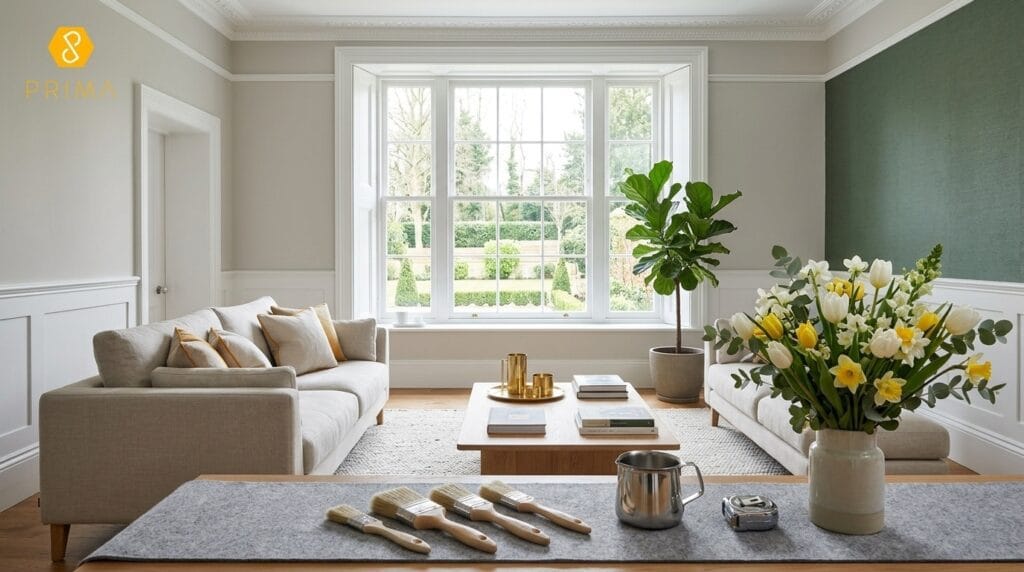
We’ve noticed a shift in the last few months. Clients aren’t coming to us with a Pinterest board full of flat, printed patterns anymore. They’re bringing swatches they want to touch, grasscloth, linen weaves, cork panels, and asking whether we can actually get hold of them. It’s not a passing fad, it’s the clearest direction wallpaper design has taken in years, and it’s worth understanding before you commit to anything for your own walls.
For a long time, wallpaper was mostly about the pattern printed onto a flat surface. That’s changing. The current wave of design is built around materials you can genuinely feel, rich grasscloth, elegant linen, robust sisal, even real cork, rather than a photograph of texture printed flat. It’s a move away from faux finishes that mimic brick or wood grain towards the real thing, which changes how a room feels as much as how it looks.
In practice, this means a dining room wall that genuinely has a woven, tactile quality under your hand, not just under good lighting. Grasscloth in particular has become one of the most requested finishes we’re fitting this year, largely because it does something paint simply can’t: it absorbs sound slightly, softens hard corners in a room, and adds warmth without needing a bold colour to do the work. It suits London’s older housing stock especially well, where a textured, natural finish sits more comfortably against original cornicing and picture rails than a stark printed pattern would.
Alongside texture, large-scale murals are becoming a genuine focal point rather than a novelty. Rather than choosing a repeating pattern, more clients are opting for a single, immersive scene, a painterly landscape, a botanical engraving, a soft cloudscape, that fills an entire wall and becomes the room’s centrepiece. It works particularly well in London flats with limited floor space, since one striking wall does the visual heavy lifting that furniture and accessories would otherwise need to do.
One trend that surprises people until they see it done properly is wallpaper on ceilings. It sounds like a lot, but in a bedroom with a soft, muted print or a subtle texture overhead, it genuinely changes how a room feels, adding a sense of intimacy that four painted walls and a plain white ceiling don’t achieve. It’s a bigger job than a standard feature wall, since ceiling installation is trickier and less forgiving of poor preparation, but it’s one of the more requested additions we’re seeing on jobs this year.
The texture shift is happening alongside a move towards richer, warmer colours generally, deep reds, plum tones, and earthy neutrals like clay and rust are replacing the cooler greys that dominated for the past decade. Paired with a textured finish, these tones read as considered and grounded rather than trend-chasing, which is probably why they’re proving popular with homeowners who want something that will still look right in five years, not just this season.
Textured materials are considerably less forgiving than a standard printed vinyl. Grasscloth and natural fibre papers can shade differently between rolls, mark permanently if handled with wet or dirty hands during installation, and need a different adhesive approach entirely to a smooth surface. This is genuinely one area where a proper wallpapering services London team earns its keep, since the margin for error on a natural fibre wall covering is much smaller than on a typical paste-the-wall vinyl print.
If you’ve been drawn to this more tactile, natural direction in wallpaper but aren’t sure which material would suit your room, get in touch with Prima Decor and we’ll talk you through what actually works on your walls, rather than just what looks good in a showroom sample.
FAQ Section
Textured, natural-fibre wallpapers such as grasscloth, linen weaves and cork are leading the current trend, moving away from flat printed patterns and faux-texture finishes towards materials with genuine tactile depth.
Generally, yes. Natural fibre papers can vary slightly in shade between rolls, mark easily during handling, and often need different adhesive techniques than smooth vinyl wallpaper, so professional installation is worth considering.
Yes, and it’s an increasingly popular way to add depth to a bedroom or living space. It’s a more involved job than a wall, since ceiling installation is less forgiving of poor surface preparation.
Very well, in most cases. The natural, tactile finish tends to sit comfortably alongside original features like cornicing and picture rails, often better than a bold printed pattern would.
Please select from below to see more:
Discover how we can help you with your decorating requirements. Call us on 020 8226 5125 or fill out our online request form and we will be in touch shortly.